



Loading your cart…
Darwin Fitness
2250 Lee Rd STE 100
Winter Park, FL 32789
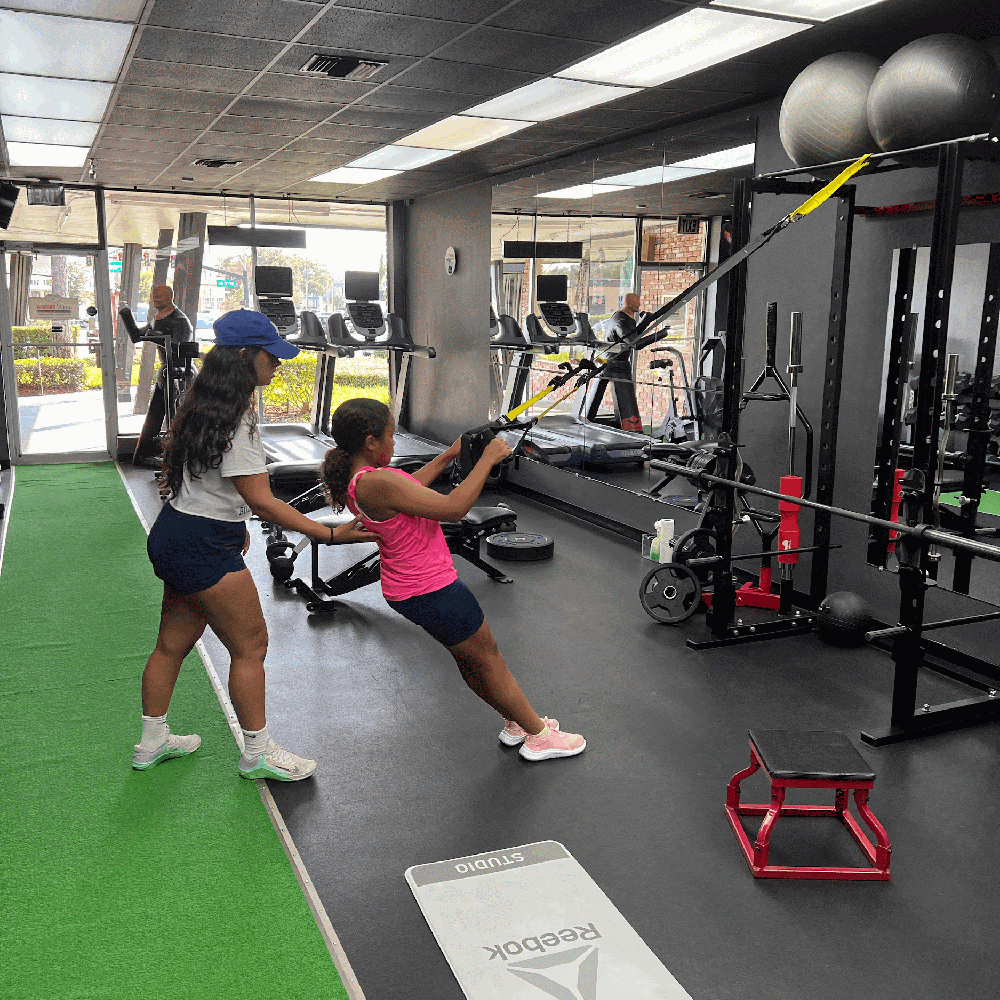
Youth Fitness: more than the scale
Nearly 35% of American children are overweight. It matters, but BMI charts miss what kids actually need.
Pr. Faigenbaum, one of the world's leading researchers in pediatric fitness, puts it plainly: "As they see themselves get stronger they gain competence and confidence and, consequently, are more likely to engage in sport activities."
What kids and teens gain from a well-designed strength program goes well beyond weight management.
That's what we are about at Darwin Fitness.
Case Study: 15-Year-Old Football Player Adds 45 Pounds to His Bench and a Faster First Step Off the Snap
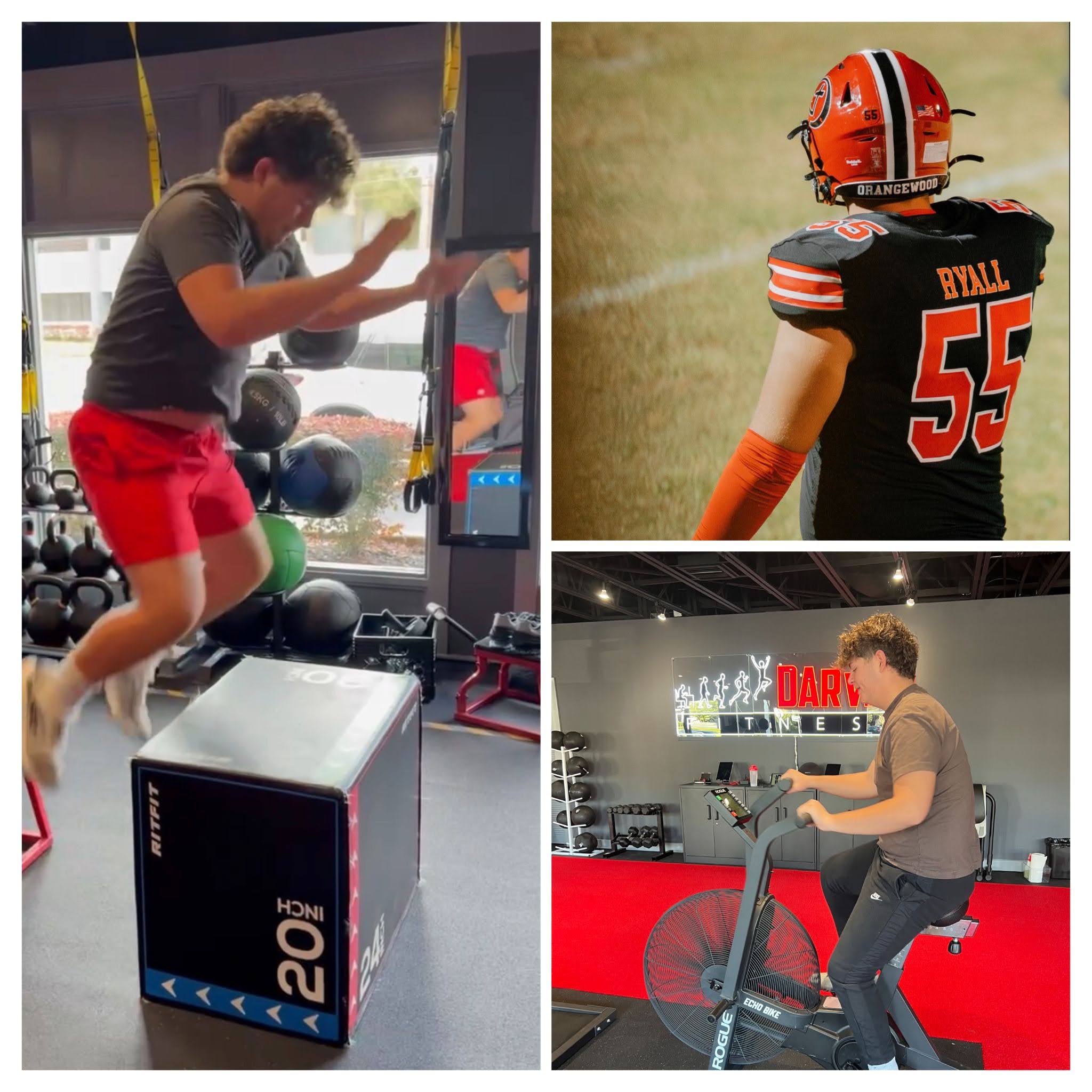
Zach’s Story
Client Profile
- Client: Zach, 15
- Location: College Park
- Primary Goal: Build the strength, power, speed, and agility a high school center needs, so his size and his technique finally work together on the field.
The Assessment
Size gets a lineman noticed. What he does with it in the first second after the snap decides the play.
Zach had the size. At 15, he already had the frame for the offensive line and the center position. What he did not have yet was time in the sport. He was heading into only his second year of football, and while his coaches were teaching him the technique, his body was still learning how to move like a football player. Coordination, balance, and athleticism were all behind where his size said they should be.
The center has one of the most demanding jobs on the field. He snaps the ball, and in the same motion he has to fire out, get his hands on a defender, and hold his ground. That comes down to two physical qualities: explosive acceleration over the first step, and raw strength to win the contact that follows. Our assessment focused on both, along with the mobility he would need to absorb a full season of hits without breaking down.
The Personalized Game Plan
Zach trained with us three times a week for three months. Every session ran a full hour, and every hour followed the same order, moving from the fastest, most technical work to the heaviest and then to the details.
- Warm Up with Purpose. Each session opened with a comprehensive warm up that did more than raise his heart rate. Mobility work for the hips, ankles, and upper back prepared him for the lifts ahead and built the range of motion that protects a lineman’s joints in a contact sport.
- Plyometrics for the First Step. While he was fresh, Zach went straight into upper and lower body plyometrics. Pogo hops taught his ankles to be stiff and reactive. Broad jumps trained horizontal power, the same direction he drives out of his stance. Single leg lateral hops built control when moving side to side, and depth jumps into box jumps taught him to absorb force and explode right back out of it, which is exactly what happens when a center meets a defender.
- Power: Moving Weight Fast. Next came one or two power exercises aimed at his rate of force development, how quickly he can produce force rather than how much. For a center, that speed is the difference between getting into a block first and getting pushed back.
- Strength: Moving Weight That Is Heavy. Then the heavy lifting. Squats, deadlifts, and bench press, performed for low reps at high loads, built the maximal strength that lets him hold his ground once contact is made. This is where his size started to become real force on the field.
- Accessories to Finish. Each hour closed with accessory work to add muscle and correct imbalances from side to side. For a young athlete still growing into his frame, this is what keeps progress balanced and his body durable.
The Measurable Result
In roughly 36 sessions, Zach’s numbers moved in a big way. His bench press went from 180 to 225 pounds, a 45 pound gain and a 25 percent jump in three months. His squat climbed from 300 to 315 pounds. Starting a squat above 300 pounds at 15 already put him ahead of most players his age, which made that extra 15 pounds harder earned.
The changes carried onto the field. Zach is quicker off the line and more agile, and he is physically better equipped to execute the technique his coaches are teaching him. He also reports less pain after practices and games, a direct payoff of the mobility and balance work built into every session. He is playing his season now, and so far without a single reported injury.
In His Own Words
“Darwin Fitness has helped me become stronger, faster, and more explosive on the football field. Their training has improved my performance and prepared me to compete at a higher level.”
Inside Darwin Fitness: Zach, 15-Year-Old Football Player 
Let’s meet to discuss your child’s goals!
Youth Personal Training
Taking into account the child's physiological needs and abilities allow for planning the most beneficial youth fitness training program.
Darwin Fitness personalizes every exercise program to the strengths and weaknesses of your child, making each workout session more efficient. We incorporate strength training to outline maintainable fitness plans for children as young as 7 years old. We make sure to always provide encouragement, constructive feedback and a positive environment that keeps kids and teens engaged and focused on their goals. Families in Winter Park, Maitland, and Orlando have trusted us with their kids and teens’ fitness since 2012.
Personal Training • Nutrition Coaching • Personal Training • Nutrition Coaching • Personal Training • Nutrition Coaching • Personal Training • Nutrition Coaching • Personal Training • Nutrition Coaching • Personal Training • Nutrition Coaching • Personal Training • Nutrition Coaching • Personal Training • Nutrition Coaching • Personal Training • Nutrition Coaching • Personal Training • Nutrition Coaching • Personal Training • Nutrition Coaching • Personal Training • Nutrition Coaching • Personal Training • Nutrition Coaching • Personal Training • Nutrition Coaching • Personal Training • Nutrition Coaching • Personal Training • Nutrition Coaching •
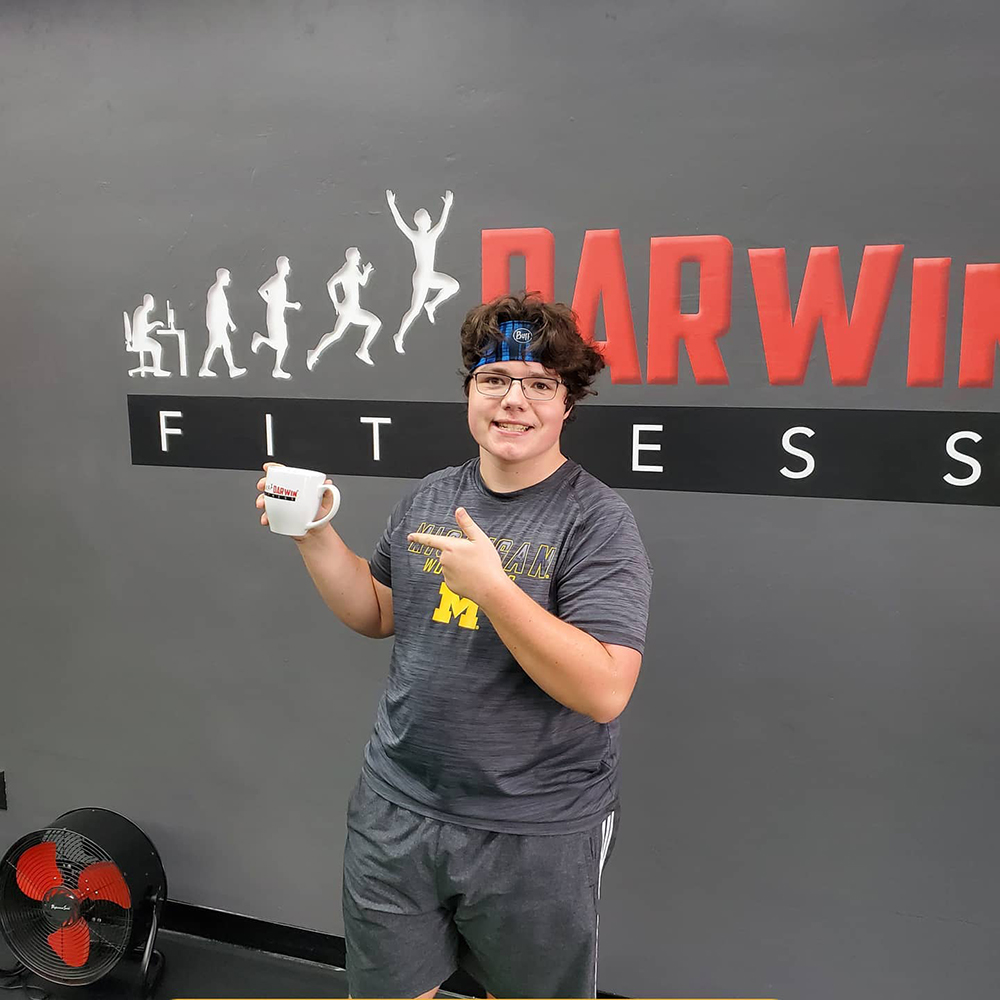
Benefits of Training with Darwin Fitness
- Reduces Fat and Increases Lean Muscle Mass
- Greater Strength Overall
- Improve Bone Density
- Ligaments and Tendons Less Susceptible to Injury
- Increased Endurance and Stamina
- More Energy All Day Long
- Improvements in Mood
- Great Boost to Self Confidence
Case Study: Faster, Stronger, More Explosive, and a Division I Scholarship
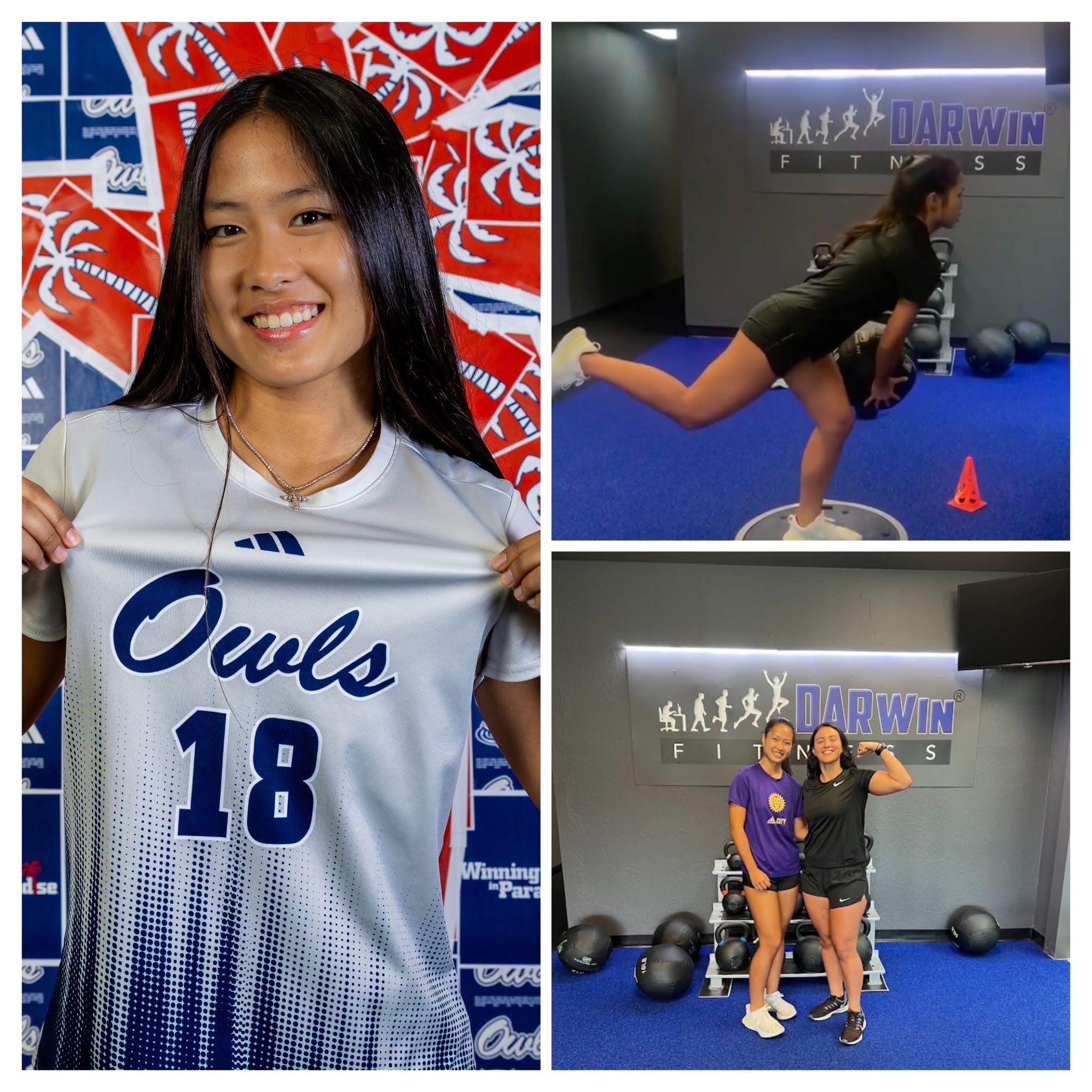
Izabel’s Story
Client Profile
- Client: Izabel
- Location: Orlando
- Training History: 3 years of training with Darwin Fitness, started at age 15
- Primary Goal: Become stronger, faster, and more explosive on the soccer field, and earn the opportunity to play at the collegiate level.
The Assessment
Izabel walked into Darwin Fitness at 15 years old knowing exactly what she wanted. She was not training to look fit. She was training to play college soccer, and every session had to move her closer to that goal.
College coaches recruit the player who wins the first step, holds her ground in a challenge, and cuts back without losing speed. So that is where we looked first. Her assessment covered lower-body strength and single-leg stability, sprint mechanics, how well she could brake from full speed, how efficiently she moved side to side, her core strength, and how much force she could drive into the ground. The picture was clear. She already had the talent and the motivation. What she needed was a stronger, faster, more resilient body to carry both to the next level.
The Personalized Game Plan
Izabel’s program was built around the moments that decide soccer games. It had five parts, and each one answered a specific question: what does she need to do better on the field?
- 1. Strength That Holds Up in a Challenge. Soccer is a contact sport played mostly on one leg, so we trained her that way. Box squats and front-loaded squat variations built raw strength through her hips and legs, while Bulgarian split squats, single-leg Romanian deadlifts, and single-leg press work made sure each leg could produce force on its own. Pull-ups rounded out her upper body, giving her the strength to shield the ball and hold off defenders shoulder to shoulder.
- 2. Winning the First Step. Most sprints in a match last only a few seconds, which means the first few steps usually decide who gets to the ball. We cleaned up her running form with sprint technique drills, then used falling starts to teach her to lean and drive hard from a standing position. Resisted sled sprints loaded that acceleration pattern, and dedicated first-step quickness work made her faster off the mark in every direction.
- 3. Braking, Cutting, and Reacting. Speed is only half the job. A player also has to stop, turn, and go again without losing balance. Deceleration drills taught Izabel to brake under control, while lateral bounds and lateral acceleration work built power moving side to side. Multi-directional movement patterns prepared her for the angles a real game throws at her, and reactive agility drills, where she responded to a live cue instead of a set pattern, trained her to read and react the way she has to during a match.
- 4. Power on Takeoff, Control on Landing. Explosiveness is what gets a player up for a header and away from a tackle. Box jumps and broad jumps developed vertical and horizontal power, single-leg plyometrics added spring to each leg, and medicine ball throws connected that power through her trunk. Just as important, we coached her landings. Absorbing force well is what protects a soccer player’s knees and ankles through a long season, so landing mechanics were part of every power session.
- 5. A Core Built for Contact. A strong core keeps an athlete balanced when she gets bumped mid-stride. Pallof press variations and anti-rotation work taught her to resist being twisted off her line, dead bug progressions sharpened control of her trunk, and farmer carries built full-body stability under load. Core stability circuits tied everything together.
The Measurable Result
The work showed up on the field. Izabel became stronger, faster, and more explosive, and she moved with far more efficiency. She accelerated harder, stopped and changed direction with more control, and put more force into every action that matters in a game.
Then came the result she had been chasing since her very first session: a scholarship to play Division I soccer at Florida Atlantic University. Our program gave her the tools, but the scholarship was earned by her own work ethic, consistency, and commitment to the process, in the gym and away from it.
In Her Own Words
“When I started at Darwin Fitness, I told them my goal was to play college soccer, and from day one they took that seriously. Every session had a purpose. I got stronger, my first step got so much quicker, and I felt way more confident going into tackles and cutting at full speed. I could feel the difference in games, and so could the coaches watching me.
Training at Darwin Fitness was a huge part of how I earned my scholarship to play Division I soccer at FAU. I’m really grateful to the whole team for believing in my goal and pushing me every week to reach it.”
Inside Darwin Fitness: Izabel, From Darwin Fitness to Division I Soccer
From the Classroom to the Gym
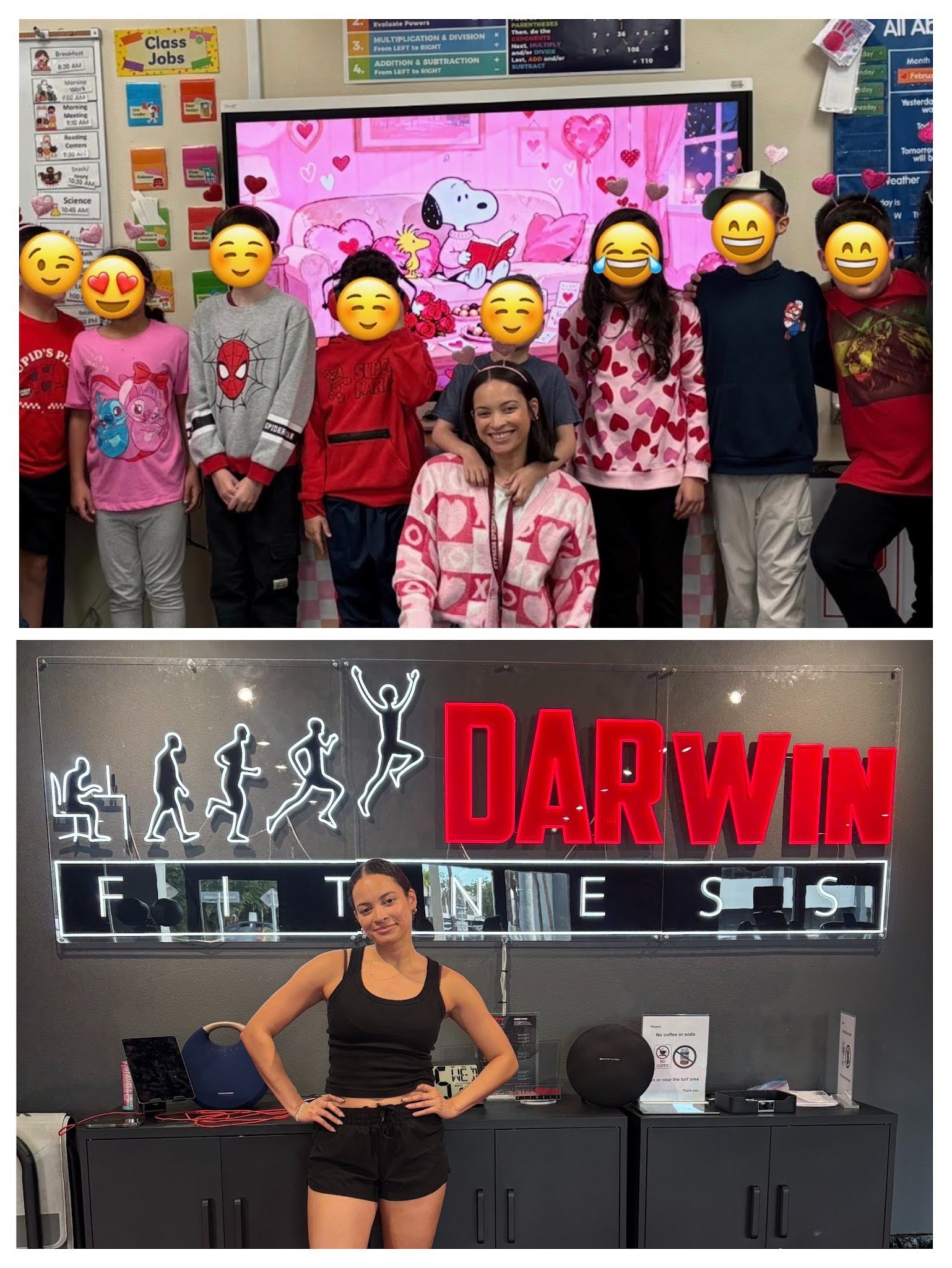
Lisa Almonte is a lead teacher for students with varying exceptionalities at Cypress Springs Elementary in Orlando, ages 7 to 12. She holds a Bachelor of Sociology from Florida State University and a Master of Arts in Teaching from Rollins College. She has trained at Darwin Fitness since 2022 and advises our youth coaches on programming for neurodivergent kids.
Many children have real differences in coordination and motor planning, so a movement that looks simple, like skipping or catching a ball, takes a lot more effort to process. Add sensory load on top of that: noise, bright lights, the feel of a mat or a sweaty shirt. Then add the social part, which is where most sports lose them. By the time the actual exercise starts, the child is already exhausted. So when a parent says their child hates exercise, I usually hear that the child hates everything around the exercise.
In my classroom, I like to start the year with having parents fill out a student interest inventory. Knowing what a child likes (activities, fictional characters, toys, games) is key to finding how to make activities fun for them, including fitness. Make the workout a game with a prize to earn if completed. Make the first wins easy. A child who succeeds in the first five minutes comes back. Only present incentives that you can actually honor in that exact moment. Provide choice within the session to help the child feel safe and engaged. Ask about exercise selection; for example, “Would you like medicine ball slams or the battle ropes first?” Let them choose how to keep track of their progress: counting out loud, a visual countdown timer, or moving a counter token into a bucket for each completed repetition.
Be as clear as possible with your direction. Model all exercises and movements. Use visual aids whenever possible, like a timer or visual schedule depicting the exercise at hand and for how long. Provide clear expectations before the workout: what the child might be working for, plus when their break time is. Remember that behavior is a form of communication. If a child begins to shut down or stop, lower the demand and build from there. Have a backup plan ready and be prepared to pivot, whether that be the movement, how you are communicating the direction, or even the tone of your voice. The Darwin Fitness personal trainers are wonderful at this; they read a child quickly and adjust with real patience and care.
Parents should be patient and encouraging. There are going to be good days and bad days when starting something new like personal training. Progress over perfection! Keeping a consistent day and time for training sessions is important. A predictable routine with the gym builds a foundation of safety, and Darwin Fitness, a private studio dedicated only to personal training, is an ideal place to build it. Communication between coach and parent is paramount. Share everything that works at home or at school, and the subtle, early behavioral signs that a child is becoming overwhelmed or frustrated. This can be very important in preventing emotional meltdowns or complete refusal of a workout.
Let’s meet to discuss your child’s goals!
Young Competitive Athletes Development
While every child needs to be relatively active under professional supervision, young athletes are especially in need of proper guidance.
These kids/teens may not play professionally yet; however, with the adequate fitness program from our private fitness coaches specialized in young athletes, the chances for your child to access the world of champions are much higher.
Our Services
- Personalized Fitness Training for Kids and Teens
- Strength Training Programs for Ages 7 and Up
- Specialized Coaching for Young Athletes
- Private Youth Fitness Coaching for College Park, Baldwin Park, Altamonte Springs, Winter Springs, Longwood and Casselberry.
Ready to transform your child's health and fitness? Contact Darwin Fitness today to schedule a free consultation. Our team is dedicated to helping your child develop healthy habits, improve athletic performance, and achieve lasting results.
Programs & Pricing
We believe in upfront pricing. Our rates are competitive, with discounts for longer commitments.
Classic Session
30-Min Sessions
from
$46
Prime Session
45-Min Sessions
from
$66
Maxi Session
60-Min Sessions
from
$84
Packages range from 12 to 144 sessions with commitment discounts.
Let’s meet to discuss your child’s goals!
Frequently Asked Questions
Kids can start personal training at Darwin Fitness from age 7 through their teen years. The American Academy of Pediatrics says readiness depends on skill and experience, not age alone. The real test is whether your child can follow instructions and wants to be there.
No, properly supervised strength training does not stunt growth. The American Academy of Pediatrics' 2020 clinical report, reaffirmed in 2024, found no apparent negative effect on growth, growth plates, or heart health. At Darwin Fitness, kids learn form with bodyweight first and never do maximal lifts.
Every family starts with a free consultation and a free workout at Darwin Fitness's private Winter Park studio. Your child meets a coach and tries a session while you discuss goals like confidence, weight, healthy habits, or sport performance.
Youth personal training at Darwin Fitness starts at $44 for 30 minutes, $63 for 45 minutes, and $79 for 60 minutes. Packages range from 12 to 144 sessions, with lower rates on longer packages.
Three sessions a week is the sweet spot for most kids, and two works well for busy schedules or in-season athletes. The CDC recommends muscle-strengthening activity at least 3 days a week for ages 6 to 17, and Darwin Fitness sessions count toward that.
Yes, Darwin Fitness trains young athletes for soccer, basketball, football, and other sports. Strength work also protects them: a 2024 meta-analysis of 21 studies found injury prevention programs cut youth team-sport injuries by about one-third.
Yes, and it has been a core Darwin Fitness specialty since 2012. The American Academy of Pediatrics recommends starting kids with overweight on basic strength exercises rather than cardio-heavy programs. Our private, appointment-only studio means no crowds and no pressure to perform in front of peers.
Yes, Darwin Fitness welcomes kids and teens with autism and other special needs at every fitness level. Our youth coaches get programming guidance from Lisa Almonte, an Orlando head teacher who works with children ages 7 to 14 with autism.
Kids at Darwin Fitness train with male and female certified personal trainers, all background-checked and CPR/First Aid certified. The team includes coaches with exercise science and kinesiology degrees and college athletic backgrounds, and we match each child with the coach who best fits their goals and personality.
Darwin Fitness is at 2250 Lee Rd, STE 100, Winter Park, FL 32789, minutes from Winter Park High School, Bishop Moore, and Lake Highland Prep. The ground-floor studio has private parking at the front door, so you can drop off your teen or wait on site.
Client Success Stories
Clients of all ages and fitness levels trust us with their goals: from weight loss to senior functional fitness, youth athletic training, sports performance, and post-therapy strength rebuilding.
Ideally Located for Busy Families in Greater Orlando
Safe, Central, and Convenient for Your Child’s Training
Since 2012, Darwin Fitness has been a trusted environment for youth fitness and athletic development. Our private gym is centrally situated at 2250 Lee Rd, STE 100, Winter Park, acting as the perfect hub between school, home, and your other daily activities in Orange and Seminole counties.
We are located on the ground floor with a private parking lot right at the front door. For parents, this means a safe, visible drop-off point for your teen, or a hassle-free parking spot if you choose to wait—making the logistics of youth training simple and stress-free.
How Do I Get To Darwin Fitness?
Winter Park families will find us easy to reach from anywhere in the city. Drive north along US 17-92 (Orlando Ave) or take Denning Drive to reach Lee Road, then head west. Our facility is at 2250 Lee Rd, Winter Park, 32789, right by the I-4 interchange. It’s a short family drive to a focused, positive training environment where your young athlete can thrive.
Getting your teen here from Baldwin Park couldn’t be more convenient. Simply drive north on Bennett Rd or North Semoran Blvd and connect to Lee Rd. We’re at 2250 Lee Rd, Winter Park, 32789—most families arrive in under 10 minutes. Pull directly into our private lot, skip any parking garage complications, and your child can walk straight in ready to train.
College Park families have it easy. Take Princeton St or Fairbanks Ave to Orange Ave, follow it to Lee Rd, and you’re here. Find us at 2250 Lee Rd, Winter Park, 32789. The drive takes 10 to 12 minutes with easy parking on arrival—no time wasted before your student athlete’s session begins.
The drive from Altamonte Springs is quick and family-friendly. Head south on US 17-92 (Orlando Ave) toward Winter Park, turn onto Lee Rd, and look for 2250 Lee Rd, Winter Park, 32789. About 10 minutes door to door. Park easily, walk in safely, and your child enters a supervised, professional space—no crowded commercial gym distractions.
Maitland families have the shortest commute of all. Head south on US 17-92 (Orlando Ave), turn onto Lee Rd, and you’ve arrived at 2250 Lee Rd, Winter Park, 32789. Eight minutes on average. A quick trip that brings your young athlete to a private gym built for healthy development and lasting habits.
Need to get your teen out of the downtown area? Hop on I-4 North, exit at Fairbanks Ave or Lee Rd, and head east into Winter Park. Our studio is at 2250 Lee Rd, Winter Park, 32789. Most families make it in about 10 minutes. No hunting for street parking—just pull up, drop off, and know your teen is in a safe, mentorship-focused environment.
Longwood families enjoy a smooth highway route. Take I-4 West toward Orlando, exit at Lee Rd, and head east to 2250 Lee Rd, Winter Park, 32789. Roughly 15 minutes depending on traffic. Parking is never an issue, so fitting youth training sessions into your busy family schedule stays simple.
From Casselberry, head west on FL-436 (Semoran Blvd) or US-17-92 toward Winter Park and turn onto Lee Rd. We are at 2250 Lee Rd, Winter Park, 32789. Usually 10 to 12 minutes. A direct shot with no strip mall parking lots to navigate—just show up and your child can start building strength and confidence.
Winter Springs is closer than you think. Use FL-434 or Tuskawilla Rd to connect to FL-436 (Semoran Blvd) heading south, then turn onto Lee Rd. You will find us at 2250 Lee Rd, Winter Park, 32789. Around 15 minutes gets your young athlete to a private facility where building healthy habits and athletic foundations is our complete focus.